Hot weather is when a backyard pool earns its keep in San Diego County, and it is also when the pool’s surface and water are under the most stress. Warm water uses up sanitizer faster, evaporation concentrates minerals, and heavier use puts more feet on the steps and benches. Most of the resulting problems are small and manageable if you know what to look for. This article explains how heat affects pool surfaces, walking areas and water chemistry, how to separate normal evaporation from a possible leak, and how to decide whether an issue calls for maintenance, a repair or a closer look at the finish.
The effect varies across the county. Coastal neighborhoods often stay mild under the marine layer while inland valleys and East County communities run much hotter, so an inland pool will usually show these changes sooner and more strongly.
How heat changes pool water chemistry
Heat does not damage plaster directly, because the surface is underwater. What heat does is make the water harder to keep in balance, and unbalanced water is what affects the surface over time:
- Sanitizer is used up faster. Warm water, strong sun and more swimmers all increase chlorine demand. When chlorine runs low, algae and cloudy water follow quickly.
- pH tends to drift. Heavy use and warm water can push pH up, and high pH combined with high calcium favors scale.
- Evaporation concentrates minerals. As water evaporates, calcium and dissolved solids stay behind. Topping off with fresh water helps, but it also changes the balance, so the water should be retested afterwards.
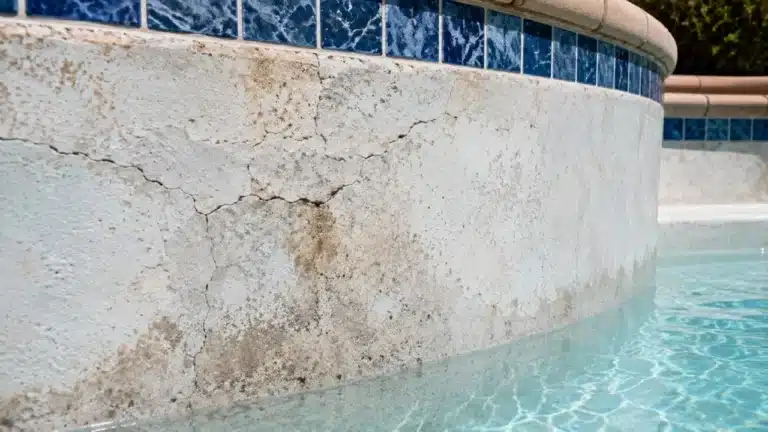
Water that tends to form scale leaves crusty deposits on the surface and tile line. Water that is aggressive (for example, from low pH or low calcium) slowly dissolves plaster and leaves it rough. Either way, the surface feels the effect of the chemistry.
Pool surfaces, steps and walking areas in hot weather
The steps, benches, sun shelves and swim-outs take the most foot traffic, so they are where heat-season problems show up first:
- Roughness: often scale building up faster in warm, mineral-rich water, or older plaster that has worn and become etched.
- Slippery areas: algae takes hold quickly on steps and in corners when sanitizer falls behind.
- Chips and sharp edges: small chips at step edges can cut feet, especially with children going in and out all day.
- Hot surfaces out of the water: coping and decking can get very hot in direct sun, which is a comfort and safety issue rather than a sign of damage.
Not every rough surface needs resurfacing. Roughness caused by scale can often be improved by correcting the water balance and cleaning. Roughness from worn or etched plaster cannot be cleaned away. Our article on why a pool surface feels rough explains how to tell which one you have.
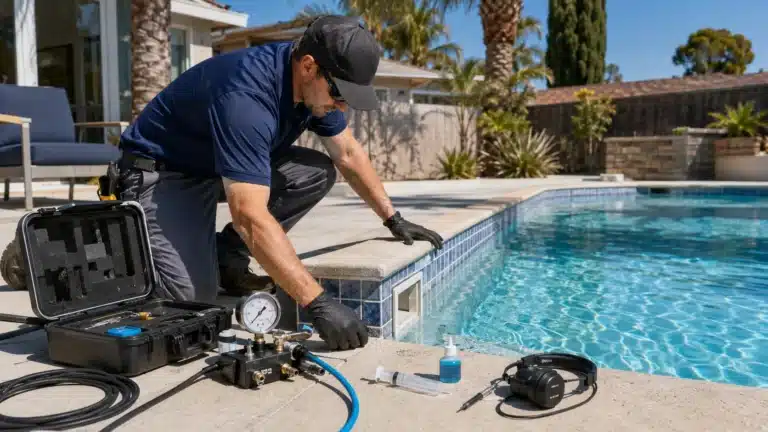
Evaporation or a possible leak?
Pools lose more water in hot, dry and windy weather, so a falling water level in summer is not automatically a leak. Signs that it may be more than evaporation include:
- the level drops noticeably faster than usual for the weather;
- the loss continues at the same rate on cooler or calmer days;
- the level drops more when the pump runs, or stops at a particular fitting or the skimmer opening;
- there are wet spots, soft ground or cracks near the pool.
A simple bucket test compares the pool’s loss with the evaporation from a bucket of pool water placed on a step. Our guide to telling a leak from evaporation explains how to run it. If the pool is losing more than the bucket, leak detection is the next step.
Inspecting an existing finish during the warm months
A short monthly check through the warm season catches most issues early:
- run a hand over the steps, benches and shelves and note any rough or sharp spots;
- look for new stains, discoloration that does not brush away, or white crusty lines at the waterline;
- look for chips, hollow-sounding areas or plaster that seems to be lifting;
- check for cracks, and whether any known cracks are getting longer or wider;
- watch the water level through the week, as above.
Our pool surface maintenance guide has a fuller routine.
When maintenance is likely to solve the problem
- cloudy water or algae that clears with correct sanitizer levels, brushing and circulation;
- light scale that responds to chemistry correction and cleaning;
- stains that fade with brushing or targeted treatment;
- a water level that tracks evaporation in a bucket test.
When a repair or resurfacing evaluation makes sense
- roughness across large areas that stays after the water has been balanced and brushed;
- chipped, delaminating or hollow-sounding plaster, especially on steps and benches where people walk;
- cracks that are growing, or water loss that is higher than evaporation;
- stains that keep coming back across the surface.
Isolated damage can often be handled with a localized surface repair. Widespread wear is when resurfacing is usually evaluated; our article on signs a pool needs resurfacing covers the indicators.
Safety during high-use days
Hot days bring more swimmers, more guests and more children. Surface condition is part of pool safety: keep steps free of algae, deal with sharp or chipped spots promptly, make sure gates and barriers work, and keep an adult actively watching the water. If the ocean is rough and more people swim at home, the same basics apply with more people in the pool.
For a heat-wave maintenance routine (sanitizer, pump run time and water level), see San Diego heat wave pool care. For humid and stormy late-summer weather, see heat, humidity and pool surface care.
Frequently Asked Questions
Does hot weather damage pool plaster?
Not directly. Heat makes water chemistry harder to keep in balance, and water that is scale-forming or aggressive for long periods is what roughens, stains or wears plaster.
Why do the pool steps feel rough in summer?
Often because scale builds up faster in warm water with concentrated minerals, or because older plaster on high-traffic steps has worn. Scale may improve with chemistry correction and cleaning; worn plaster does not.
How much water loss is normal in hot weather?
It depends on sun, wind, humidity and whether the pool is covered, so there is no single number. A bucket test on your own pool is the reliable way to compare actual loss with evaporation.
Should I resurface my pool because it feels rough?
Not necessarily. Check the water balance and clean first. If roughness is widespread and remains after that, have the surface evaluated to see whether a repair or resurfacing is the right next step.
How often should I test my water during hot weather?
Sanitizer and pH several times a week, and more often during heavy use; alkalinity and calcium hardness at least weekly, and after topping off.
Keeping your pool ready for hot weather
Most heat-season pool problems start as chemistry problems and are easiest to fix early. If roughness, chips, cracks or water loss persist after the basics, Baja Pool Plaster works on existing pools across San Diego County and can evaluate the surface. You can request a free written estimate.